An air conditioner blows warm air when something stops it from moving heat out of your home. The seven most common causes are wrong settings, a dirty filter, a blocked outdoor unit, low refrigerant from a leak, a frozen indoor coil, a failed electrical part, or a failed compressor. The first three you can usually check and fix yourself in about 15 minutes. The last four need a licensed technician.
At Solus Air, our ARCtick-licensed technicians handle breakdown calls across NSW, the ACT, Queensland, Victoria, South Australia and Western Australia. On every warm-air call we work through the same list below, in the same order, starting with the simple checks. It’s worth running those checks yourself before you book anyone, because some warm-air problems need nothing more than a clean filter or a change of mode on the remote.
Below we cover each cause, how to spot it, what you can safely do yourself, and when to turn the system off and call a professional.
How does an air conditioner cool your home?
An air conditioner cools your home by pulling heat out of the indoor air and releasing it outside.
Here’s how it works on a split system. The indoor fan pushes room air over a cold coil called the evaporator. Refrigerant in that coil absorbs the heat. The compressor in the outdoor unit then pumps the refrigerant to the outdoor coil, called the condenser, where a fan blows that heat outside. Ducted systems work the same way, with ductwork carrying the cooled air to each room.
That gives you a useful way to think about warm air. Something in that loop has stopped working:
- Air can’t get through, because of a dirty filter, blocked vents or a frozen coil.
- Heat can’t get out, because the outdoor unit is dirty, blocked or not running.
- The refrigerant cycle has stopped, because of a leak, an electrical fault or a failed compressor.
1. Are your thermostat or remote settings wrong?
Wrong settings are the easiest cause to rule out, so check them first. On a reverse cycle system, the unit may be in heat, fan, dry or auto mode rather than cool.
Check these four things on the remote or wall controller:
- Mode is set to cool. The snowflake symbol on most remotes. Fan mode just moves room air around, and it will feel warm on a hot day.
- The set temperature is below the room temperature. If the room is 26°C and the unit is set to 27°C, it has nothing to do.
- The remote or controller batteries are good. Flat batteries can stop a new setting from reaching the unit.
- In a ducted system, the zones you want are switched on. A closed zone can make one room feel like the system has failed.
For summer, the Australian Government’s YourHome guide recommends 25 to 27°C. Setting 18°C won’t cool the room any faster, and it makes the system run longer. The government’s energy.gov.au site says you can save up to 10% on cooling for each degree you raise the setting.
DIY fix: Correct the mode, set a temperature a few degrees below the room, replace the batteries and give it 10 minutes. If a wall thermostat still misreads the room or won’t trigger cooling, it may need repair or replacement by a technician.
2. Is a dirty air filter blocking the airflow?
A clogged filter is one of the most common reasons a system cools poorly. It chokes the air moving over the indoor coil. The system then works harder, cools less and, in bad cases, lets the coil freeze (see cause 5).
Consumer group CHOICE says cleaning the dust filters every few weeks is recommended, and at least twice a year. The Australian Government’s energy.gov.au confirms that cleaning filters improves efficiency and is a job the householder can do.
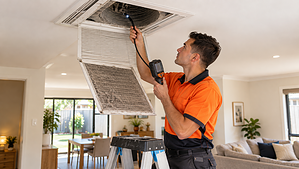
DIY fix: Turn the unit off. On a split system, lift the front panel and slide out the mesh filters. Vacuum them or wash them in warm soapy water, then let them dry completely before you refit them. On a ducted system, the filter sits behind the return air grille in the ceiling or hallway.
If the return air grille and ducts are thick with dust even after a filter clean, that’s a separate job. A professional duct and vent clean covers the ductwork, vents and return air path.
3. Is the outdoor unit dirty or blocked?
If the outdoor unit can’t get rid of heat, the air inside stays warm. Leaves, grass clippings, overgrown plants, stored boxes and a layer of dirt on the coil fins all act like insulation around it.
Sun matters too. The same YourHome guide advises that the outdoor compressor should be shaded from direct sun. A unit baking on a west-facing wall on a 40°C afternoon has a harder job than one in the shade.
DIY fix:
- Switch the unit off at the isolation switch next to the outdoor unit.
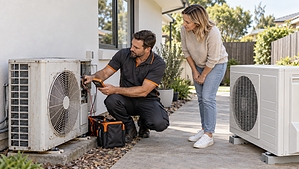
- Clear away plants, rubbish and anything stored against it, keeping to the clearances in your unit’s installation manual.
- Gently hose the coil fins from the outside in, with low pressure. A pressure washer will flatten the fins.
- Wait for it to dry, switch it back on and check the outdoor fan is spinning.
If the fins are badly bent, heavily corroded or packed with dirt that a hose won’t shift, a technician can do a chemical coil clean and straighten the fins. This is common on outdoor units near the coast, where salt corrodes the fins over time.
4. Is your air conditioner low on refrigerant?
If the system is low on refrigerant, it has a leak. Air conditioners don’t use up refrigerant. It circulates in a sealed loop, so a low charge means gas is escaping somewhere.
Signs of a refrigerant leak include:
- The system runs for long periods but never gets the room cool.
- Ice forming on the thin copper pipe at the outdoor unit or on the indoor coil.
- A hissing or bubbling sound near the pipework.
- Oily residue on pipe joints.
There’s no DIY fix here. Under Australian law, a refrigerant handling licence from the Australian Refrigeration Council must be held by anyone servicing or maintaining air conditioning equipment where refrigerant could escape. Handling refrigerant without one is an offence.
A proper repair means finding the leak, fixing it, pressure testing the system, then recharging it to the manufacturer’s specification. We’ll be direct about one thing that costs us work to say. A regas without a leak repair only buys you time. If someone offers to top up the gas without looking for the leak, ask them where the gas is going.
5. Is the indoor coil frozen?
A frozen evaporator coil blocks airflow and stops cooling. It sounds strange on a hot day, but it happens when too little warm air passes over the coil, or when the refrigerant charge is low. Moisture in the air then freezes onto the coil and builds up.
You may see frost or ice on the indoor coil behind the front panel, ice on the copper pipes, or water dripping from the indoor unit as it melts.
DIY fix: Turn cooling off and run the unit on fan only, so the ice can thaw. This can take several hours. While it thaws, clean the filter and make sure no supply vents or return grilles are closed or blocked. Then try cooling again.
If the coil freezes a second time, the cause is deeper. It’s usually a refrigerant leak or a failing indoor fan motor. Thawing it yourself is a temporary fix, so book a technician to find the root cause.
6. Has an electrical part failed?
Electrical faults can leave the indoor fan running while the outdoor unit does nothing. You get air, but no cooling.
The usual suspects are:
- Capacitor. This part gives the compressor and outdoor fan motor the kick they need to start. It’s the most common single point of failure we see, and a failed one often shows up as a humming outdoor unit that won’t start.
- Contactor. The switch that sends power to the outdoor unit. If it sticks or burns out, the outdoor unit won’t run.
- Fan motors. A failed indoor fan motor stops air moving over the coil. A failed outdoor fan motor stops heat leaving the system.
- Control boards and sensors. Faulty sensors can tell the system the room is already cool.
DIY fix: Check the switchboard for a tripped circuit breaker or safety switch, and check that the outdoor isolation switch is on. That’s where DIY stops. If the breaker trips again after one reset, leave it off. Repeated tripping points to an electrical fault, and electrical work on an air conditioner must be done by a licensed professional.
7. Has the compressor failed?
The compressor is the heart of the system. If it overheats, locks up or fails, the refrigerant stops moving and the system can only blow room-temperature or warm air.
Signs of a compressor fault include loud clicking, grinding or buzzing from the outdoor unit, an outdoor fan that spins while the unit stays warm, and a breaker that trips when the system tries to cool.
DIY fix: Turn the system off. Running a system that’s blowing warm air can make a struggling compressor fail completely, and that’s the most expensive part in the system.
Compressor repair or replacement always needs a licensed technician. It’s also where the repair or replace question gets serious. The rule of thumb we use is this: if a repair on a system over ten years old costs more than half the price of a new one, replace it. At that point, a new system sized to your rooms usually makes more sense than a major repair on an old one.
Which warm-air problems can you fix yourself?
| Cause | Common signs | Can you fix it yourself? | What a technician does |
| Wrong settings | Unit in fan, heat or auto mode, or set above room temperature | Yes | Repairs or replaces a faulty wall thermostat |
| Dirty filter | Weak airflow, dusty filter, poor cooling | Yes | Deep cleans the indoor coil and checks airflow |
| Blocked outdoor unit | Debris around the unit, dirty fins, outdoor unit hot to touch | Yes, with a hose | Chemical coil clean, straightens damaged fins |
| Refrigerant leak | Long run times, ice on pipes, hissing | No, licence required | Finds and repairs the leak, pressure tests, recharges |
| Frozen coil | Ice on the indoor coil or pipes, dripping water | Thaw only | Finds the cause, usually a leak or fan motor fault |
| Electrical fault | Indoor fan runs but outdoor unit doesn’t, humming, tripped breaker | Reset breaker once | Tests and replaces capacitors, contactors, motors or boards |
| Compressor failure | Clicking or grinding, outdoor unit runs with no cooling | No | Repairs or replaces the compressor, or advises on replacing the system |
When is warm air not a fault?
Sometimes the system is working fine, and something else explains the warm air. Rule these out before you book a call-out:
- The system has just started. Most units wait a few minutes before the compressor starts, to protect it. Warm air in the first few minutes is normal.
- It’s a very hot day. On a 40°C-plus afternoon, a system that’s working properly may only manage slightly cool air. It’s removing heat as fast as it can.
- The system is too small for the space. CHOICE notes that a system needs to be the right size for the space, and that insulation, location and orientation also have a significant impact on cooling. A unit sized for a bedroom won’t cool an open-plan living area.
- A ducted outlet blows hot air in one room only. This often points to a disconnected or split duct in the roof space, which then blows hot roof-cavity air into the room. A technician needs to repair the ductwork, but the air conditioner itself is usually fine.
When should you call an air conditioning technician?
Call a licensed technician if the three DIY checks (settings, filter, outdoor unit) haven’t brought back cold air within about 30 minutes. Call straight away if you notice any of these:
- Ice on the coil or pipes that comes back after thawing
- Hissing, bubbling or oily pipe joints
- A breaker that trips more than once
- Clicking, grinding or buzzing from the outdoor unit
- A burning or electrical smell
Turn the system off while you wait. Then tell the technician which checks you’ve already done, because it cuts diagnosis time.
Before any work starts, you should get a diagnosis before a price. The technician should name the fault and give you a fixed quote before touching the system. That’s how we run breakdown calls at Solus Air. Our breakdown and repair assessment starts at $239 for new customers, and you see the repair price before any work starts. Whoever you book, ask for their ARCtick licence number. If you want the full list of questions, we cover it in our guide to choosing an air conditioning technician.
How do you stop your air conditioner blowing warm air again?
Most of the causes above can be prevented. Filters, outdoor coils and early electrical faults are exactly what routine maintenance deals with.
- Clean the filters every few weeks during heavy use, and at least twice a year.
- Keep the outdoor unit clear of plants and stored items, and hose the fins at the start of summer.
- Book an annual service for ducted systems and for any split system over five years old. A professional service cleans the coils, clears the drain, checks refrigerant pressure and tests the electrical parts.
- Book in autumn or early spring, not December. A worn capacitor found in October is a simple part swap. The same part failing in January can mean a compressor that tried to start against it, plus an emergency call-out in the busiest week of the year.
If you want to know what to budget, we break down air conditioner servicing costs and what a service should include.
Frequently asked questions
Why is my split system blowing warm air in cool mode?
If the mode and temperature are set correctly, the most likely causes are a dirty filter or a blocked outdoor unit. If the outdoor unit isn’t running at all, suspect an electrical fault such as a failed capacitor.
Why is my air conditioner blowing warm air after a regas?
The leak that caused the low charge was probably never repaired, so the new gas has escaped too. A technician needs to find and fix the leak, then recharge the system to the manufacturer’s specification.
Why is my ducted air conditioner blowing hot air in one room only?
Check that the zone is switched on and the outlet is open. If it is, a disconnected or damaged duct in the roof space is a common cause, and a technician will need to inspect the ductwork.
Can I regas my own air conditioner?
No. In Australia, handling refrigerant requires a licence from the Australian Refrigeration Council, and doing it without one is an offence. A low charge also means there’s a leak that needs repairing first.
Is it safe to keep running an air conditioner that blows warm air?
No. Once the simple checks are done, turn it off. Running a system with a leak, a frozen coil or an electrical fault can damage the compressor and turn a small repair into a big one.
Where to start
If your air conditioner is blowing warm air right now, start with the settings, then the filter, then the outdoor unit. Those three checks take about 15 minutes and can often fix the problem without a call-out.
If cold air is back, clean the filters more often and book a service before next summer. If it isn’t, or you’ve seen ice, heard hissing or had a breaker trip, turn the system off and get it diagnosed.
Our technicians work across Australia in NSW, the ACT, Queensland, Victoria, South Australia and Western Australia. Book a repair and you’ll have the fault named and a fixed price in writing before any work begins.