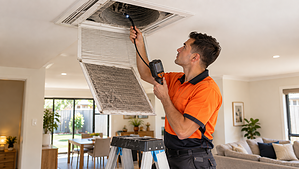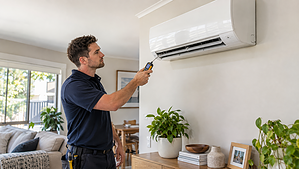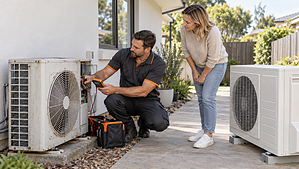
Air conditioner servicing in New South Wales costs about $120 to $180 for a single split system and $180 to $350 for a ducted system. Most NSW households land close to $150 for a routine annual service, which covers cleaning the coils and filters, clearing the condensate drain, checking refrigerant levels and electrical connections, and testing the system end to end.
Consumer group CHOICE prices the same job at around $150 for a call-out plus time on site, and says you can expect to pay something similar for an annual service “assuming there are no other problems.” At Solus Air we service split and ducted systems across New South Wales, from Sydney CBD out to Bathurst, Orange and Wagga Wagga, and that last clause is where nearly all the price variation lives.
No Australian government body, regulator or consumer organisation publishes an average servicing price. The ranges on this page are composite trade figures, cross-checked against CHOICE wherever CHOICE publishes something comparable. Below we cover what a service includes, what pushes the price up, and what the adjacent jobs cost in NSW: repairs, a regas, a new ducted system, and the electricity to run it.
What does an air conditioner service in NSW include?
A routine service is a clean, a check and a test. On a standard split system it takes about 45 minutes.
Here is what a service covers on most residential jobs:
- Indoor and outdoor coil cleaning. Dust on the evaporator coil is the biggest single cause of lost cooling capacity.
- Filter wash or replacement. The part you can do yourself, and should, between services.
- Condensate drain clearing. Blocked drains are the most common cause of water dripping from an indoor unit in a Sydney summer.
- Refrigerant level check. A pressure check, not a top-up. If the level is low, something is leaking.
- Electrical connection check. Terminals, contactors and the capacitor, which is the most common single point of failure.
- A full run test in both cooling and heating. Reverse cycle systems fail in one mode more often than both.
A service is not a duct clean, a regas or a repair. Those are separate jobs at separate prices, and a service advertised as including a “free regas” is either padding the price or hiding a leak.
Why do air conditioner servicing prices vary so much?
Time on site, almost always. The published range is wide because a 45 minute job and a two hour job get billed differently.
The things that actually move the number:
- System type. A ducted system has a central unit, a return air filter, zone motors and dampers to test. That is why ducted sits at $180 to $350 rather than $120 to $180.
- Number of indoor heads. Each head on a multi-split is its own clean, its own filter and its own test. A four head system is close to four times the work of a single split.
- How long since the last service. A system serviced every year takes 45 minutes. One that has never been serviced can take two hours and may need a deeper coil clean.
- Access. Roof space entry, second storey mounting, tight side passages and outdoor units on brackets all add time.
- Location. Regional NSW attracts travel loading that Sydney metro does not. Coastal systems from Wollongong to Newcastle also carry salt corrosion on the outdoor coil, which adds cleaning time.
- When you book. December and January are the tightest weeks of the year for every technician in the state, and after hours or emergency call-outs are priced differently to a scheduled service.
| Job | Typical NSW cost | What is usually included |
| Split system service, single head | $120 to $180 | Coil clean, filters, drain, refrigerant check, electrical check, run test |
| Ducted system service | $180 to $350 | As above, plus return air filter, zone motors and dampers tested |
| Routine annual service, all types | Around $150 | CHOICE’s figure for a call-out plus time on site with no faults found |
| Ducted duct cleaning | Quoted after inspection | A separate job covering vents, ducts, return air and the indoor unit |
Service ranges are composite trade figures for NSW in 2026. The $150 figure is CHOICE’s published estimate for a technician call-out and annual service. No government body publishes an average.
Duct cleaning is worth separating out, because it gets sold as servicing and it is a different job. A duct clean covers vents, ducts and return air through the whole run, rather than the mechanical check the system needs annually. Most ducted homes need a duct clean occasionally. All of them need the annual check.
How much does air conditioner repair cost in NSW in 2026?
Air conditioner repairs in NSW typically run $150 to $1,200, and the part that failed decides where in that range you land. Small faults sit near the bottom, compressor and motor failures near the top.
Most jobs come in cheaper than homeowners expect. Airtasker’s national cost data, drawn from jobs booked on its own platform and last updated in June 2025, puts the median air conditioning repair quote at $190, with most jobs between $70 and $250. Read that as a floor rather than a market average, because marketplace jobs skew towards simple work, and simple work is exactly the kind that does not blow out.
| Repair | Typical NSW cost | Repair or replace? |
| Diagnostic visit or tune-up | $150 to $250 | Always worth it before agreeing to anything |
| Minor fix: blocked drain, sensor, deep clean | $150 to $300 | Repair |
| Capacitor replacement | $250 to $450 | Repair, on any system |
| Refrigerant leak found and repaired, plus regas | $250 to $600 | Repair once, replace if it leaks twice |
| Compressor or motor replacement | $800 to $1,200 | Usually replace if the system is out of warranty |
Composite trade ranges for NSW in 2026, cross-checked against Airtasker’s published national median repair quote of $190.
The number that matters more than any of these is the diagnostic fee, because it decides whether you are buying an answer or a guess. Our own model, and the one worth insisting on from anyone you book, is a diagnosis before a price: the technician identifies the fault, quotes the repair, and credits the diagnostic against the work if you approve it. A technician who quotes a repair over the phone has not seen the fault.
One rule of thumb we use, and it costs us work to say it. If a repair on a system over ten years old comes to more than half the price of replacing it, replace it. Old systems that need a compressor rarely need only a compressor.
How much does an air conditioner regas cost in NSW?
A regas in NSW costs roughly $200 to $600. Split systems sit around $250 to $400 and ducted systems around $350 to $600, with about $350 being typical across the state.
Air conditioners do not consume refrigerants. It is a sealed system, so if yours is low it has a leak, and a regas without a leak repair buys you one more summer at most. Any technician who tops you up without finding the leak has sold you a consumable.
Refrigerant work is also regulated. Under Australian law a refrigerant handling licence from the Australian Refrigeration Council must be held by anyone servicing, maintaining or decommissioning air conditioning equipment, and handling refrigerant without one is an offence. Ask for the licence number. It takes ten seconds to check.
If your system runs on R22, the calculation changes. The Australian Government has capped HCFC imports since 2016, and from 1 January 2030 bulk R22 imports will be banned entirely, after which servicing relies on reclaimed refrigerant only. The official advice is that a working R22 system does not need replacing, but that prices may rise and parts get harder to source. A large regas on an R22 ducted system is the point at which replacement deserves a serious look.
How much does ducted air conditioning cost in NSW?
Ducted reverse cycle installation in NSW runs about $8,000 to $15,000 for a standard three or four bedroom house, rising to $12,000 to $20,000 for larger or two storey homes. Sydney sits at the top of that spread rather than in the middle of it. Our own published Sydney figures are $12,000 to $17,000 for ducted through a whole house, against $1,800 to $4,800 for a single split system, and the gap is mostly labour.
Those ranges sit inside the independent picture. CHOICE says you will be hard-pressed to buy a ducted reverse cycle system for less than $5000 including installation, that a typical freestanding house “can easily reach $10,000 or more,” and that a large or multi-storey home is “probably looking at $15,000 or more.”
Ducted costs several times what a split costs because you are paying for a building job as much as a cooling job: a central unit, ductwork through the roof space, vents cut into ceilings across the house, a controller and usually zoning. The electrical work is a real line item too. In NSW any electrical wiring work must be done by a licensed electrician who lodges a Certificate of Compliance for Electrical Work, so a quote that says “electrical if required” is not a quote.
What decides whether a ducted system is good value is capacity, and capacity should be measured before it is priced, from your rooms, ceiling heights, window orientation and insulation, rather than copied off the system being replaced. A capacity figure copied from an old unit is a guess wearing a number, and it is the most expensive mistake available on a ducted job.
How much does it cost to run air conditioning in NSW?
Running an air conditioner in NSW costs about 23 to 35 cents an hour for a bedroom split system and roughly $1.30 an hour for a ducted system with all zones open. Your exact figure is your system’s power draw multiplied by your electricity rate.
Both halves of that are public. NSW regulated usage rates for 2026-27, set by the Australian Energy Regulator in its Default Market Offer, are 33.1 cents per kilowatt hour in the Ausgrid zone covering most of Sydney, Newcastle and the Central Coast, 33.7 cents in the Endeavour Energy zone covering western and south western Sydney and the Illawarra, and 35.0 cents in the Essential Energy zone covering regional NSW. Your system’s power draw is on its specification plate or data sheet, and the Zoned Energy Rating Label lets you compare capacity, star rating and total energy consumption across three Australian climate zones before you buy.
| System | Power draw while running | Cost per hour at 33.1c | Cost per hour at 35.0c | 6 hours a day for a 90 day summer, at 33.1c |
| 2.5 kW split, bedroom | About 0.7 kW | 23c | 25c | $125 |
| 3.5 kW split, living area | About 1.0 kW | 33c | 35c | $179 |
| 7 kW multi-split or large split | About 2.0 kW | 66c | 70c | $358 |
| 14 kW ducted, all zones open | About 4.0 kW | $1.33 | $1.40 | $716 |
Rates from the AER Default Market Offer 2026-27, including GST, effective 1 July 2026. Power draw figures are indicative, so check the label on your own system. Real bills come in lower than the last column, because systems cycle rather than run continuously and ducted systems rarely run every zone.
Two levers change that number more than anything a technician can do. The Australian Government’s energy.gov.au states you can save up to 10% for each degree you raise the cooling setpoint. Its YourHome guidance frames the same effect slightly differently, saying each extra degree of cooling “increases energy consumption by about 5 to 10%,” and recommends 25 to 27°C in summer. Both are government sources and they are not identical claims, so we give you both rather than the flattering one.
The second lever is scale. YourHome puts heating and cooling at around 40% of household energy use, while energy.gov.au gives a wider 20% to 50% range across climate zones. Either way it is the largest single item on the bill, which is why two degrees on the thermostat beats almost every efficiency tweak available.
Does servicing actually save you money?
Sometimes, and we will be specific about when, because “servicing pays for itself” is a claim the industry makes far too loosely.
A service reliably saves money when the system is dirty, when it is ducted, or when it is more than about five years old. CHOICE is direct about the mechanism. A clogged air conditioner will struggle to draw in air, cool it and send it back out into your home, and it works harder to do it, burning more electricity for less cooling. On a ducted system running $700 a summer, recovering even 10% of that pays the service back in the first year.
It saves less on a two year old split system in a clean house where the owner washes the filters. CHOICE recommends cleaning dust filters “every few weeks” and at least twice a year, and says householders can do it themselves. If that is your situation, you can stretch to every second year without much risk, and we would rather tell you that than book a job that does nothing.
Where servicing earns its keep regardless is the failures it catches early. A worn capacitor found in October is a $250 to $450 part. The same capacitor found in January is a compressor that tried to start against it, plus an emergency call-out in the worst week of the year.
How often should you service an air conditioner in NSW?
Once a year for ducted systems and for any split system over five years old. Every two years is defensible for a newer split in a low dust household where the owner cleans the filters.
The Australian Government’s YourHome guidance is less prescriptive and worth repeating: service all heaters and coolers “according to the manufacturer’s instructions,” and pay special attention to cleaning air filters. Most manufacturers specify annual servicing, and most also make warranty claims conditional on it, which is the practical reason to keep the receipts.
Book in autumn or early spring. December bookings across NSW fill up weeks ahead, and a fault found in March gets fixed on your timeline instead of during a heatwave.
Five questions to ask before you book a service
Fifteen minutes on the phone prevents most billing surprises.
- Is this a fixed price or a call-out plus time? Both are legitimate. Only one lets you compare two quotes.
- What is included, item by item? Coils, filters, drain, refrigerant pressure check, electrical check, run test. If any of those are extra, you want to know now.
- What is the diagnostic fee, and is it credited if I approve the work? Ask this even when booking a routine service, because a service that uncovers a fault turns into a repair conversation on the spot.
- What is your refrigerant handling licence number? Any legitimate technician answers this without hesitating.
- What warranty applies to the work? Under Australian Consumer Law, services must be carried out with care and skill, which applies whether or not a business offers its own guarantee on top.
Frequently asked questions
Do you need a licence to service an air conditioner in NSW?
Yes, for anything involving refrigerant. The Australian Refrigeration Council requires a refrigerant handling licence for installing, commissioning, servicing, maintaining or decommissioning air conditioning equipment, and any electrical wiring work needs a separately licensed electrician. Washing your own filters requires neither.
How long does an air conditioner service take?
About 45 minutes for a standard split system. A ducted system usually takes 60 to 90 minutes because of the zone motors, dampers and return air filter, and a multi-split takes longer with each additional indoor head.
Can I service my own air conditioner?
You can do the filters, and you should. CHOICE recommends cleaning dust filters every few weeks and at least twice a year, washing them in warm soapy water and drying them completely before refitting. Coils, refrigerant and anything electrical need a licensed technician.
Is it cheaper to service an air conditioner in winter?
The hourly rate usually is not, but the total often is, because winter and shoulder season jobs are scheduled rather than urgent. Emergency and after hours call-outs in a NSW summer are priced differently to a booked service in May.
What is the difference between a service and a duct clean?
A service is a mechanical check and clean of the unit itself. A duct clean covers the ductwork, vents and return air path running through your ceiling. Most ducted homes need a service every year and a duct clean occasionally, usually after a renovation, a rodent problem or a period of visible dust.
Does servicing a reverse cycle system cover the heating side?
It should. A proper service tests both modes, because reverse cycle systems commonly fail in one mode while working in the other. If your system is gas ducted rather than reverse cycle, that is a different job again and sits under heating repair and service.
Where to start
If your system is under five years old, cooling properly, and you clean the filters, you do not need to book anything today. Put a reminder in for early spring and wash the filters this weekend.
If your system is ducted, over five years old, or has not been touched in more than 12 months, book a service before summer and ask for the five things listed above in writing. On a ducted system the service will very likely pay for itself in running costs alone.
And if a technician tells you the system needs a regas, ask one question before agreeing: where is the leak? A system that needs gas has a fault, and topping it up without finding that fault is the most common way NSW homeowners pay twice.
If you want a fixed price before anyone touches your system, our technicians work across New South Wales from Sydney metro to the Hunter, the Illawarra and the Central West. Book a service and you will have the scope and the price in writing before we start.