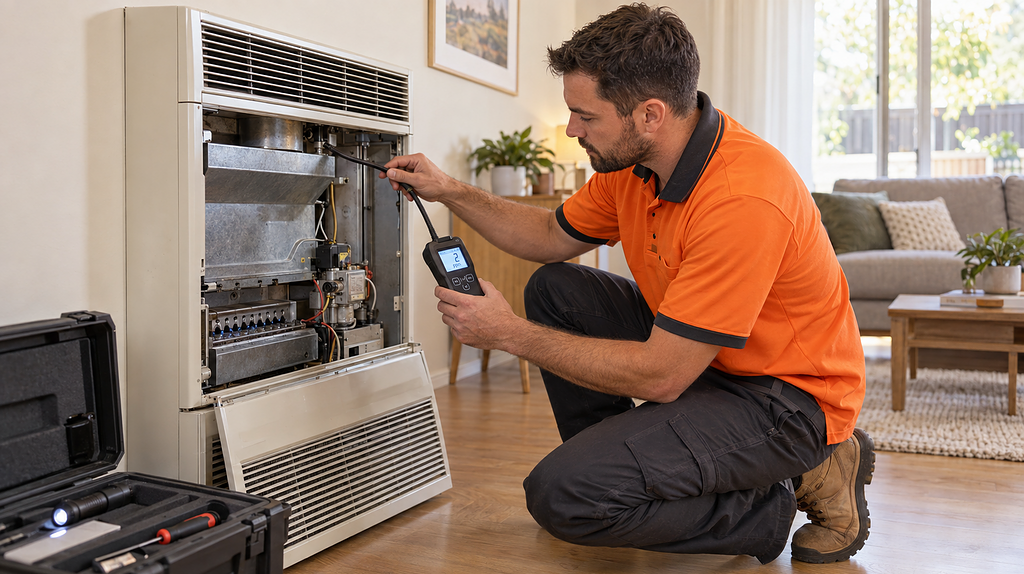
A gas heater service is a safety and maintenance check carried out by a licensed gasfitter. A full service covers seven tasks. The gasfitter cleans the burner, checks gas pressure and connections, tests the flue and ventilation, inspects the heat exchanger for cracks, tests the safety controls and ignition, checks for gas leaks, and runs a carbon monoxide (CO) spillage test. Energy Safe Victoria recommends a service at least every two years.
Servicing is important because any gas heater, old or new, can leak carbon monoxide, a gas you cannot see or smell. At Solus Air, our technicians are licensed to work on gas systems and service heaters in six states and territories, and every gas service we carry out includes a carbon monoxide test with a certified report. That test is the one check that tells you whether a heater is safe to run in a closed room. Regular servicing also keeps the heater burning efficiently, which means lower gas use and a lower chance of a mid-winter breakdown.
This guide explains each step of a service, why the CO test matters most, how often you need one, who can legally do it, and the warning signs that mean you should book one now.
What does a gas heater service include?
A standard gas heater service includes seven checks. Australian Gas Networks lists the first six as the core scope, and Victoria’s health and safety regulators add the carbon monoxide spillage test as an essential part of every service.
| Service task | What the gasfitter does | What it prevents |
| Burner and combustion clean | Removes dust and debris, checks for a steady blue flame | Incomplete combustion, which produces carbon monoxide |
| Gas pressure and supply check | Measures gas pressure and inspects connections and seals | Poor heating, unstable flames and gas escaping |
| Flue and ventilation test | Confirms exhaust gases are drawn up and out of the home | Carbon monoxide spilling back into the room |
| Heat exchanger inspection | Looks for cracks, corrosion or wear | Hidden CO leaks into the air you breathe |
| Safety controls and ignition test | Tests the thermostat, ignition, flame sensors and shut-off devices | Unsafe ignition and gas flowing without a flame |
| Gas leak check | Tests fittings and pipe joints for leaks | Fire and explosion risk |
| Carbon monoxide spillage test | Measures CO around the heater and in the room while it runs | Carbon monoxide poisoning |
Most gasfitters finish with a check of overall performance, confirming the heater reaches temperature and cycles normally. You should also get a written record of what was checked and anything that needs repair.
What happens during the burner and flame check?
The gasfitter cleans the burner and watches the flame. A healthy flame burns mostly blue. A yellow, orange or sooty flame is a sign of incomplete combustion, which is when a heater starts producing carbon monoxide. A dirty burner is one possible cause, and the gasfitter will clean it and adjust the gas supply to restore a clean flame.
Why is the heat exchanger inspection important?
The heat exchanger separates the burning gas from the air that heats your home. In a ducted gas heater, a crack here can let combustion gases, including carbon monoxide, mix with the warm air sent to every room. Cracks are not always visible from outside the unit, which is why this is a job for a gasfitter with the right tools.
What is a carbon monoxide spillage test?
A carbon monoxide spillage test checks whether CO is escaping from the heater into your home. According to Victoria’s Building and Plumbing Commission, the gasfitter checks “different parts of the heater and the room it is in to make sure there is no carbon monoxide in the air.”
The test is usually paired with a negative pressure test. Kitchen rangehoods and bathroom fans can pull air out of a room faster than it is replaced. When that happens, air can be drawn back down the heater’s flue, bringing carbon monoxide with it. The gasfitter runs the heater with the fans on to see whether this happens in your home.
If CO is found and the fault cannot be fixed on the spot, the gasfitter must disable the heater until it is repaired.
Can a heater that passed its last test fail the next one?
Yes. A pass two years ago does not guarantee a pass today. A new rangehood, a renovation that sealed up draughts, or a flue blocked by a bird’s nest can change how air moves around the heater. At Solus Air, this is why we treat the CO test as part of every gas service, including on heaters that passed last time.
Why is servicing a gas heater important?
Servicing a gas heater is important for four reasons: carbon monoxide safety, gas leak prevention, running costs and reliability.
Carbon monoxide can come from any gas heater
Energy Safe Victoria warns that CO “can make you very sick or even kill you.” Its gas heating safety guide says any gas heater can spill CO, “including old and new heaters, central heating units, space heaters, wall furnaces and decorative log fires.”
Because you cannot see or smell carbon monoxide, early symptoms are easy to mistake for a cold or tiredness. The Better Health Channel lists these symptoms of CO exposure:
- Headaches and dizziness
- Tiredness and weakness
- Nausea
- Shortness of breath
- Confusion
- Chest pain
If you suspect carbon monoxide, turn the heater off, open windows and doors, and get everyone into fresh air. Then have a licensed gasfitter check the heater before you use it again.
Gas leaks and faulty controls are a fire risk
A service checks every fitting and joint for leaks and confirms the safety shut-off works. A worn seal or a faulty flame sensor can let gas flow when it should not. These faults are rarely obvious until they become dangerous.
A clean heater uses less gas
Dust on the burner and a poorly tuned gas pressure make a heater work harder for the same warmth. Australian Gas Networks notes that skipping services leads to reduced heating performance and “higher gas usage as an inefficient heater works harder.” A service cleans the burner and sets the gas pressure correctly, so more of the gas you pay for turns into heat.
Servicing catches small faults before winter breakdowns
Australian Gas Networks warns that an unserviced heater has a higher likelihood of breaking down mid-winter, when appointment availability is lower. A service in autumn can find worn igniters, failing thermocouples and dirty flame sensors while they are still small repairs. It also means you are not competing for a gasfitter during the first cold snap.
How often should a gas heater be serviced?
Gas heaters should be serviced at least once every two years by a licensed gasfitter. This is the interval recommended by Energy Safe Victoria, the Better Health Channel and Victoria’s Building and Plumbing Commission, and it applies to all gas heater types.
Some situations call for a service more often:
- Older heaters. Australian Gas Networks advises that “the older the heater, the more frequently it warrants attention.”
- Manufacturer requirements. Some manufacturers set shorter intervals, and missing them can affect your warranty.
- Heavy use. Homes in cold climates that run the heater most days from May to September put more wear on it.
- Changes to the home. New exhaust fans, renovations or draught sealing change how air moves around the heater. If you have an open-flued heater, the Building and Plumbing Commission recommends a negative pressure and CO spillage test before you seal up your home for energy efficiency.
Do landlords have to service gas heaters?
In Victoria, yes. Under Consumer Affairs Victoria rules, rental providers must arrange a gas safety check every two years for new agreements entered into after 29 March 2021. The check must be done by a gasfitter endorsed for Type A gas appliance servicing, and renters can request a copy of the latest record, which must be provided within 7 days. Requirements differ in other states, so landlords outside Victoria should check with their state’s fair trading or tenancy body.
What are the signs your gas heater needs a service now?
Some warning signs mean you should book a service straight away, regardless of when the heater was last checked. The Better Health Channel and Australian Gas Networks list these:
- A yellow, orange or sooty flame instead of blue (decorative log fires are the exception)
- A pilot light that keeps going out, or pops and bangs when lighting
- A persistent gas smell, chemical odour or burning smell
- Soot stains or discolouration on the wall or heater panels
- Walls near the heater that are too hot to touch
- Unusual noises, poor heating or repeated ignition failures
- It has been more than two years since the last service
If you smell gas, turn the heater off at the appliance, avoid using switches or flames, open windows and call a licensed gasfitter or your gas distributor’s emergency line.
Does a service differ for ducted, wall and space heaters?
The core checks are the same for every gas heater, but each type has its own focus areas.
| Heater type | Where the gasfitter pays extra attention |
| Ducted gas heating | Heat exchanger condition, return air filter, fan and ductwork connections |
| Gas wall furnace | Flue connection through the wall or roof, burner and wall clearances |
| Open-flued space heater | CO spillage and negative pressure, since these spill CO more easily |
| Flueless portable heater | Room ventilation and CO levels, since exhaust vents straight into the room |
| Decorative gas log fire | Flue draw, burner and log placement, soot build-up |
| Gas hydronic boiler | Burner, flue, water pressure and circulation pump |
Energy Safe Victoria singles out open-flued heaters because they “can spill carbon monoxide more easily than other types of heaters.” If you have one, the two-year interval is a minimum, and you should always let some fresh air into the room while it runs.
For ducted systems, the heater service covers the unit itself. Dust in the ducts and vents is a separate job, and a ducted system clean is worth considering if the ducts have not been cleaned in years or vents are blowing visible dust.
Who can service a gas heater?
Only a licensed gasfitter can legally service a gas heater. That covers any work on the burner, heat exchanger, gas connections or internal parts. In Victoria, domestic gas heater servicing requires a gasfitter endorsed in Type A gas appliance servicing. Other states have their own gas licensing, so ask to see the licence card and check the classes listed on it.
Homeowners can safely handle a few basic tasks between services:
- Cleaning or replacing the return air filter on a ducted system
- Dusting the outside of the heater and keeping the area around it clear
- Checking that vents and the flue terminal outside are not blocked by plants or stored items
Any work behind a panel should be left to a licensed gasfitter.
At Solus Air, our technicians hold the gas trade licence relevant to their state, and they service gas ducted and wall heaters, as well as hydronic systems, across NSW, the ACT, Victoria, Queensland, South Australia and Western Australia.
What should you get after a gas heater service?
After a service, you should get a written record of what was done. A good service report includes:
- The gasfitter’s name, business details and licence number
- The date of the service
- The results of the CO spillage and negative pressure tests
- Any faults found, repairs completed and repairs still needed
Keep this record. It is your evidence for warranty claims, the baseline for the next service and, for Victorian landlords, a legal requirement. If the report flags a cracked heat exchanger on an older unit, it is also the point to weigh repair against replacement. For some homes, switching to reverse-cycle makes more sense than a major repair on a heater near the end of its life.
Frequently asked questions
Is a carbon monoxide test part of every gas heater service?
It should be. The Better Health Channel says all gas heaters should be serviced every two years “and tested for carbon monoxide spillage.” Some providers list it separately, so confirm it is included when you book.
Does a new gas heater need servicing?
Yes. Energy Safe Victoria states that new heaters can spill CO too. Some manufacturers also set their own service intervals, so check your warranty conditions.
Can I service my own gas heater?
No. Only a licensed gasfitter can work on the burner, gas connections or internal parts. You can clean or replace the filter on a ducted system and keep the heater and its vents clear.
What happens if the gasfitter finds carbon monoxide?
The gasfitter will try to fix the cause, such as a blocked flue or dirty burner. If the fault cannot be fixed safely, the gasfitter must disable the heater until it is repaired or replaced.
Can I run my rangehood while the gas heater is on?
It is best not to. Energy Safe Victoria advises against running rangehoods, bathroom fans or toilet fans at the same time as your heater, because they can draw CO back down the flue.
Do I still need a service if I have a carbon monoxide alarm?
Yes. A CO alarm only warns you once CO is present, and only where the alarm is placed. A service finds and fixes the cause. If you buy an alarm, Energy Safe Victoria recommends one that meets the US UL2034 or European EN50291 standard.
Keep your gas heater safe this winter
A gas heater service is a short visit that covers the burner, gas supply, flue, heat exchanger, controls, leaks and carbon monoxide. Book one at least every two years, sooner if your heater is older, open-flued or showing any of the warning signs above, and keep the report each time.
If your heater is due, book a gas heater service with Solus Air. Every gas service we carry out includes a carbon monoxide test with a certified report, so you know your heater is safe before the cold sets in.